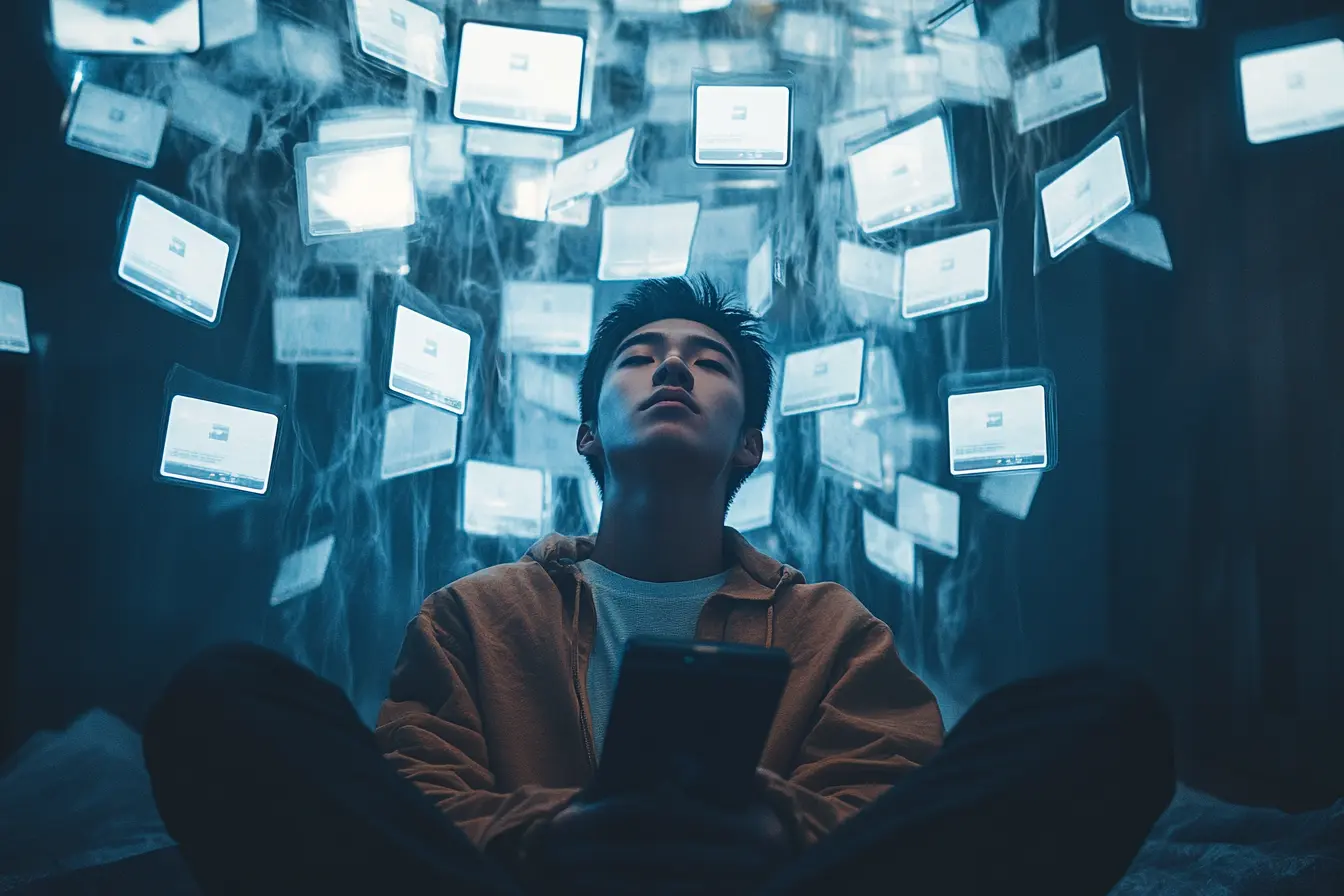
The Modern Sleep Dilemma: How Screens Captured Our Bedtime
It’s midnight, and you’re watching a video about traditional Japanese joinery. You’ve never picked up a saw. You don’t intend to. And yet here you are, forty minutes deep into a subject you didn’t know existed two hours ago, when you climbed into bed for an early night.
This isn’t a willpower failure. It’s by design. And the sleep cost is real: Jaffer et al. (2024) found that each hour of bedtime screen use is linked to a 59% higher risk of insomnia. That same research puts the average sleep loss at around 24 minutes per hour of pre-bed screen time. Do that most evenings and you’re losing the equivalent of a full night’s sleep every month.
I’m not going to tell you to throw your phone across the room. I see patients every week who’ve tried the cold-turkey approach and lasted four days. These are practical strategies grounded in what the evidence shows.
How Screens Hijack Your Sleep Cycle: The Neurological Evidence
The Blue Light Effect
Your eyes contain light-sensitive receptors that are tuned to blue wavelengths. Phones, tablets, laptops, TVs – all emit blue light in abundance. Hit those receptors in the evening and your pineal gland reads the signal as daytime, holding back the melatonin your body needs to wind down (Šmotek et al., 2020).
The knock-on effect is what sleep researchers call “phase delay”: your body clock shifts back, keeping you alert when you should be drowsy. Haghani et al. (2024) link chronic circadian disruption of this kind to mood disorders, cognitive impairment and metabolic changes affecting weight and energy. Poor sleep is rarely just about being tired the next morning.
The Mental Health Connection
The light is only part of the problem. Content and context matter too. Leung and Torres (2021) found that teenagers spending more than four hours daily on screens had measurably higher rates of depression and anxiety compared to lower-use peers. That’s a correlation, not a clean causal chain, but it’s consistent across multiple studies.
The pattern I see in clinic is a loop: poor sleep drives more late-night scrolling as people seek distraction or comfort, and the scrolling then makes the sleep worse. Tang et al. (2021) note that it’s not screen time alone driving these mental health associations – the content and the motivation behind the use both matter. Doom-scrolling news at 11pm, or checking work messages, generates a stress response at precisely the moment your nervous system should be decelerating.
There’s also “social jetlag” – the gap between your biological sleep timing and the schedule society imposes. Most people know what jet lag feels like. When I explain that the same thing can happen without catching a flight, it tends to land. Evening screen use widens that gap, and the accumulated fatigue chips away at mental resilience over time.
Screen-Induced Sleep Disruption: Measuring the Physiological Costs
Sleep Architecture Disruption
Evening screen use doesn’t only delay the moment you fall asleep. It restructures your night. Sleep runs through cycles, with deep slow-wave sleep and REM doing the heavy lifting for physical recovery, memory consolidation and emotional regulation. Blue light exposure in the hours before bed disrupts that architecture in measurable ways:
- Reduces deep slow-wave sleep by up to 30%
- Decreases REM sleep quality and duration
- Blunts the morning cortisol rise your body needs to feel alert
Eight hours in bed and still groggy? This is often why. The time was there. The quality wasn’t.
The Content Effect
Screen content shapes sleep quality as much as screen light does. A few patterns worth knowing:
- Stress-inducing content (news, work emails) triggers cortisol release, putting your body in a state incompatible with sleep
- Social media’s comparison dynamic fragments sleep onset and increases night-waking
- Passive scrolling causes more disruption than active, purposeful engagement
- Sleep deprivation pushes you toward passive scrolling – which then deepens the deprivation
Think of your nervous system as a dimmer switch rather than an on/off toggle. Pre-sleep activities set the level it starts from when your head hits the pillow.
5 Ways To Set Digital Boundaries For Better Sleep
None of this is about digital abstinence. It’s about putting some distance between the scroll and the pillow. These are the approaches with the clearest evidence behind them.
1. The 8:8:8 Rule
A hard cutoff is hard to keep. A stepped wind-down works better because your brain gets a gradual cue that sleep is coming:
- 8:00 pm: Switch on blue light filters across all devices (reduces melatonin suppression by around 58%)
- 8:30 pm: Move to lower-stimulation digital use (planning, calm content)
- 8:45 pm: Off screens entirely – reading, stretching, whatever settles you
Adjust the times to suit your actual bedtime. The principle is the stagger, not the specific hour.
2. Sort Your Bedroom
Environmental changes tend to outlast willpower. A few that show up well in the research:
- Phone out of the bedroom: Sleep metrics improve within a week. This is the single change with the most consistent evidence behind it.
- Charge devices away from the bed, ideally near wherever you start your morning routine
- Add friction to the habit: putting your phone in another room, or even face-down in a drawer, cuts habitual pick-ups by 20-35%
- Leave something else to hand: a book, a notebook, something that gives your hands somewhere else to go
The most common pushback I get when I suggest this is “I use it as my alarm.” Buy an alarm clock. A basic one costs £5 and doesn’t send you notifications at 2am.
3. Manage the Light
Screen light is the most controllable variable. If evening screen use is unavoidable:
- Blue-blocking glasses: the evidence is dubious, and I’d rather help someone change the habit than treat the effect. That said, for genuinely unavoidable late sessions, they’re not harmful.
- E-ink readers without backlighting (basic Kindle models) sit closer to physical books in terms of sleep impact than backlit tablets
- Dim the room lighting as well – screen-only filters miss the ambient light your eyes are reading alongside
Addressing room and screen lighting together works better than focusing on one alone.
4. Change How You Use Screens
If you’re going to use screens in the evening, how you use them matters:
- Active over passive: writing, messaging, planning – these disrupt sleep less than open-ended scrolling
- Sit upright: lying in bed with a phone is worse for sleep onset than using a device at a desk or on the sofa
- One thing at a time: task-switching between apps or tabs raises cognitive arousal more than focused use
Purposeful screen use causes less sleep disruption than passive consumption. That’s not permission to scroll indefinitely – it’s a useful distinction if you can’t cut evening use entirely.
5. Start Small
Perrault et al. (2019) found sleep improvements even when people pushed back screen use by ten minutes. That’s a low bar. A few other approaches with evidence behind them:
- Start with your phone: smartphone-specific limits deliver around 65% of the benefit of cutting all screens – good return for a single change
- Track it: visible progress – even just noting bedtime each morning – tends to reinforce the habit
- Consider a short reset: 72 hours of reduced evening screen use can normalise disrupted melatonin patterns, with benefits lasting 9-14 days
- 80% is enough: consistent limits on most evenings still deliver around two-thirds of the full benefit
When I raise screen time as part of sleep hygiene, I tend to assume patients are already doing the basics – no caffeine after 2pm, regular wake time, and so on. The screen question is often where the gap is. And the pushback is rarely “I didn’t know.” It’s usually “I know, but I still do it.”
A note: You don’t need to use every strategy here. Pick one that fits your actual life and try it for a week. The best approach is the one you’ll stick to. Mix and match as you go.
Digital Boundaries FAQ: Your Top Digital Boundary Questions Answered
What’s the optimal time to stop using screens before bed?
The research points to 90 minutes as a good target – melatonin levels tend to normalise within 60-90 minutes of stopping blue light exposure. That said, even a 30-minute buffer makes a difference. If 90 minutes isn’t realistic most evenings, start with 30 and build from there.
Do different age groups need different digital boundaries?
Yes. Teenagers are considerably more sensitive to blue light than adults – some research suggests up to ten times more – so earlier cutoffs (two to three hours before bed) are worth prioritising for younger people. For adults over 65, the natural yellowing of the lens filters some blue light, so consistent routine tends to matter more than strict cutoff times.
Can the damage from chronic screen use be reversed?
Yes, and it happens faster than most people expect. A 2024 study found that melatonin patterns normalised after just 72 hours of reduced evening screen use. Sleep architecture – the balance of sleep stages – tends to improve within five to seven days of consistent changes.
Are some types of evening screen use less disruptive than others?
Active, purposeful use (messaging, writing, planning) disrupts sleep less than passive consumption like scrolling or binge-watching. Content matters too – negative or stressful material is two to three times more disruptive than neutral content. If screens are unavoidable, calmer content and active engagement both help.
What about reading on a tablet or e-reader before bed?
The device type makes a real difference. Non-backlit e-ink readers (standard Kindles, for instance) produce sleep metrics close to physical books. Backlit tablets still cause some disruption even with blue light filters on, though less than phones. For evening reading, a non-backlit e-ink device with warm ambient lighting is the best option.
How can I maintain digital boundaries when my job requires evening screen work?
A protective window approach works well here. If evening screen work is unavoidable, protect at least the 60-90 minutes before sleep as a screen-free zone. Pair that with blue-blocking glasses during the work itself, maximum blue light filtering on devices, and a clear physical separation between where you work and where you sleep.
Do these same principles apply to television, or just phones and computers?
TVs cause less disruption than close-range devices – around 30-40% less melatonin suppression over the same duration, largely because of viewing distance. Television still affects sleep quality though. If you’re prioritising where to start, close-range interactive devices (phones especially) are worth addressing first.
From Screen-Tied to Well-Rested: Your Practical Sleep Reclamation Guide
People who keep consistent evening screen limits gain around 97 extra hours of sleep a year. That’s more than four full nights. Worth knowing.
If you want a starting point, these three changes have the best evidence-to-effort ratio:
- Phone out of the bedroom
- A 30-90 minute screen-free window before sleep
- Replace passive scrolling with something active – or nothing at all
Pick one. Try it for a week. See what shifts.