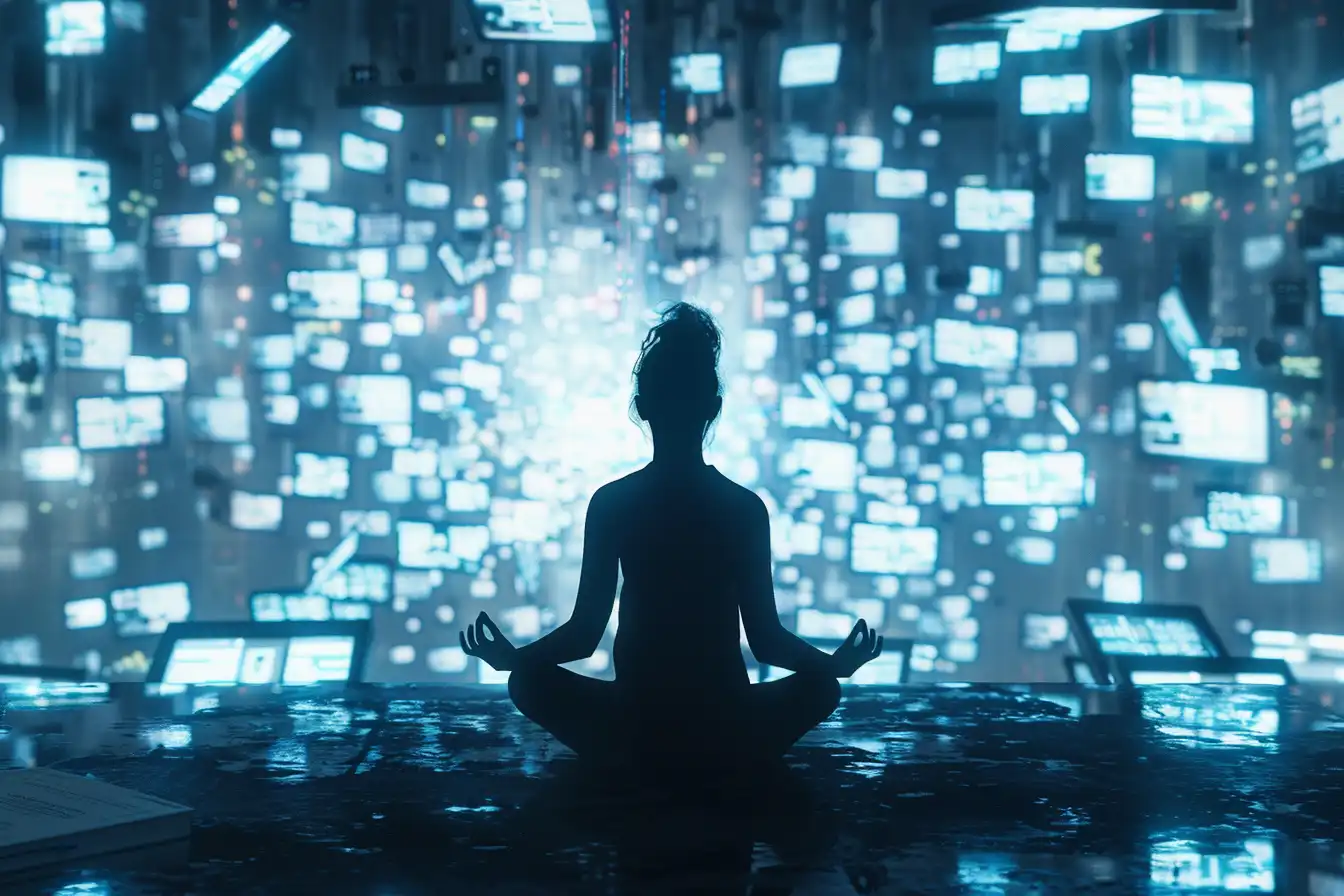
Finding Focus in a Distracted World
I see it in patients all the time — people who are exhausted but can’t explain why. They’re sleeping, eating reasonably well, not doing anything obviously wrong. Then you scratch the surface and find they’re checking their phones seventy times a day, doomscrolling through their lunch break, and going to bed with a head full of news they can’t do anything about. Information overload is a real and underappreciated source of mental strain.
Being more deliberate about what you let into your mind — your information diet — is one of the more effective things you can do for your wellbeing. Not a digital detox, not going off-grid. Just being more conscious about what you consume and when.
The Mental Health Cost of Information Overload
How Constant Connectivity Affects the Brain
The endless news cycle, social media feeds, and constant notifications keep us in a state of continuous partial attention — aware of everything, focused on nothing. Our brains weren’t built for this. The result is scattered thinking, rising anxiety, and a diminished capacity to regulate emotions.
Over time, chronic information overload tends to make people irritable and reactive. Small frustrations land harder. Concentration shortens. Sleep suffers. These aren’t character flaws — they’re predictable responses to a relentless cognitive load.
The remedy isn’t willpower. It’s curation. Being deliberate about what you let through is a far more sustainable approach than white-knuckling your way through the feed.
Building a Content Compass
A useful starting point is getting clear on what your media consumption is actually for. Not in an abstract sense — specifically. Are you trying to stay informed about health topics? Keep up with your industry? Connect with people you care about? Having a clear purpose makes it much easier to spot the content that doesn’t serve any of those goals.
Think of it as a compass rather than a rulebook. You’re not banning yourself from anything — you’re just making a habit of asking whether a given piece of content is taking you somewhere useful, or just filling time.
A Healthier Information Diet
I’m not a fan of strict diets in general. But an information diet? That’s a concept worth taking seriously. It’s about quality over volume — choosing content that actually enriches your life rather than just filling the gaps between other things.
The Art of Selective Exposure
Start with an honest audit of what you’re currently consuming. Not what you think you consume — what you actually do. Most people, when they check their screen time data, are surprised. Look at which apps are eating your time and ask what you’re getting from them.
Then swap, don’t just cut. If you’re losing an hour a night to celebrity gossip that leaves you feeling vaguely hollow, replace it with something that genuinely interests you — a podcast about history, a documentary, a book you’ve been meaning to read. The unfollow and mute buttons are underused. If certain accounts reliably make you feel worse, that’s useful information.
Balancing Your Digital Plate
Think about what’s actually on your digital plate. Is it a reasonable mix — some news, some learning, some leisure, some connection? Or have you drifted toward bingeing one category at the expense of others? Most people who doomscroll aren’t doing it because they love bad news; they’ve just lost the habit of choosing something better.
Revisit your habits every month or two. Your interests shift, your circumstances change, and the media environment changes constantly. A diet that served you well six months ago might need updating.
Setting Digital Boundaries
Time Management in the Digital Realm
One of the most effective things you can do is set specific time blocks for checking email, social media, and news — and then actually stick to them. Not a vague intention, but a defined window. This stops the digital world from bleeding into every hour of your day.
Turn off non-essential notifications. Every ping is an interruption, and interruptions have a compounding cost on concentration. Most things can wait. Use Do Not Disturb modes during focused work and protect your evenings the same way you’d protect a meeting you actually wanted to attend.
Carve out time that’s genuinely offline — for family, for exercise, for whatever recharges you. These aren’t luxuries. They’re the thing your real life is made of, and they deserve protection from your phone.
Intentional Interactions Online
Passive scrolling is the most draining form of digital consumption. Decide consciously who you want to engage with and why. Before commenting or sharing something, ask whether that interaction adds anything real — to you, or to the person receiving it.
This isn’t about being antisocial online. It’s about raising the signal-to-noise ratio. The time you spend online becomes more useful when you’re choosing what to engage with rather than just reacting to whatever appears.
Taking Breaks from Digital Noise
Building in regular breaks from screens is worth doing — not as punishment, but because your brain genuinely benefits from the rest. Mealtimes, mornings before you check your phone, weekends away from the news cycle. Use these gaps for something that doesn’t involve a screen: a walk, a physical book, a conversation that isn’t mediated by a device.
Periodically review your subscriptions and push notifications too. Newsletters you signed up for two years ago and never read. Apps that have permission to interrupt you at any hour. Most people find they can trim these significantly without losing anything that matters.
The goal isn’t digital minimalism for its own sake. It’s using technology on your terms — as a tool you pick up when it’s useful, not something that runs in the background of your life demanding attention.
Practical Tools and Techniques
Check your screen time data — your phone tracks this already. Most people find the numbers instructive. Once you know where the time is going, you can set app-specific limits rather than trying to rely on willpower alone.
Browser extensions that block distracting sites during work hours are useful for anyone who finds themselves on social media when they meant to be doing something else. Setting your phone display to grayscale is a small change that makes screens considerably less compelling — worth trying for a week.
If you spend long hours in front of a screen, follow the 20-20-20 rule for your eyes: every 20 minutes, look at something 20 feet away for 20 seconds. It’s a minor habit that reduces eye strain over a working day. And make time for hobbies that have nothing to do with screens — cooking, running, reading, whatever you actually enjoy. Your brain needs the contrast.
- Check and act on your screen time data weekly
- Set app limits for the specific apps consuming most of your time
- Use browser extensions to block distracting sites during work hours
- Try grayscale mode on your phone for a week
- Apply the 20-20-20 rule if you’re screen-heavy during the day
- Protect time for offline hobbies
Building Habits That Stick
Digital mindfulness isn’t a one-off reset. It’s a habit you maintain. Starting the day without immediately reaching for your phone makes a difference. Batching your email checking to two or three set times rather than checking constantly is another one that pays off quickly in reduced mental noise.
Throughout the day, notice when you’re feeling overstimulated — scattered, irritable, unable to settle. That’s usually a sign you’ve had too much input and need a break. A short walk or a few minutes away from screens is often enough to reset. Listen to the signal rather than pushing through it.
A wind-down routine in the evening is worth establishing. Screens off an hour before bed. Reading, a bath, stretching — whatever helps you decompress. The goal isn’t a rigid schedule but a consistent enough pattern that your brain learns to slow down when the day ends.
Progress matters more than perfection here. A few consistent habits, maintained over time, will do more than an intense detox that you abandon after three days. Other things worth trying:
- App time limits on your most-used social platforms
- Designated no-phone times — meals, first hour of the morning
- Replacing evening scrolling with breathwork or a short meditation
- A firm cut-off time for all apps in the evening
Taking Back Control
You don’t need to overhaul everything at once. Pick one thing from this piece — auditing your screen time, turning off notifications, protecting a phone-free hour in the evening — and try it for two weeks. See how it feels.
Most people who make even small changes to their information diet report feeling calmer and more focused within days. The volume of content available to us isn’t going to shrink. But your relationship with it can change, and that’s entirely within your control.
FAQs
Isn’t it unrealistic to unplug completely in today’s hyper-connected world?
Completely unplugging isn’t the point. The aim is to use technology with intention rather than be permanently on call to it. You’re looking for the balance where digital tools serve your goals — not the one where you’re checking your phone before you’ve had your morning coffee.
I need to stay informed. How can I keep up with the news without getting overwhelmed?
Be strategic about when and how you consume news. Pick a couple of reputable sources, set a defined window for checking them, and step away. You don’t need to monitor the news cycle in real time — the important stories will still be there when you look. Constant checking rarely makes you better informed; it mostly makes you more anxious.
How can I tell if my digital habits are actually problematic?
Some signs worth paying attention to: checking your phone during meals or conversations without thinking; feeling irritable when you can’t access your device; losing track of time online regularly; and sleep that’s consistently disrupted by late-night screen use. Any of these are worth taking seriously. It’s not about shame — it’s just useful information.
I’ve tried cutting back on social media before and always get pulled back in. Any advice?
Start by getting clear on why you want to cut back. Not in a vague way — specifically. More time for something else? Better sleep? Less background anxiety? A concrete reason is more useful than a general resolution. And swap the habit rather than just removing it — if you usually scroll at 9pm, have something else ready: a book, a podcast, a walk. Empty time tends to refill with the old habit.
My job requires me to be constantly connected. What can I do?
Even in demanding roles, there’s usually more room than people assume. Let colleagues know when you’re available and when you’re not. Use Do Not Disturb during focused work. Batch your message-checking rather than responding to everything the moment it arrives. And be honest with yourself about what’s actually required versus what’s just habit. Most urgent things can wait twenty minutes.
Further Reading and Resources
For anyone who wants to go deeper on digital wellbeing and managing media consumption:
Books
- “The Information Diet” by Clay Johnson – Treats media consumption habits like a diet, with practical strategies for more conscious informational choices.
- “Digital Minimalism” by Cal Newport – A thoughtful examination of which digital tools are worth keeping and which are quietly draining your time and attention.
- “The Shallows” by Nicholas Carr – A Pulitzer finalist exploring how internet use reshapes cognition, memory, and depth of thinking.
- “Irresistible” by Adam Alter – Examines why technology is so hard to put down and the mental health consequences of our relationship with screens.
Websites
- Center for Humane Technology – Resources and toolkits for a more deliberate relationship with technology.
- Mindful Tech Coach – Practical tips for integrating mindfulness into daily tech use.
- Digital Wellness Institute – Articles, podcasts, and resources on the relationship between technology and wellbeing.
Articles
- “Finding Focus” by Leo Babauta on Zen Habits – Practical strategies for maintaining concentration amid constant distractions.
- “How to Use Social Media Wisely and Mindfully” from Greater Good Magazine – Explores social media’s impact on wellbeing and offers grounded advice for more intentional use.