Most people have a vague sense that fibre is good for them. They picture bran flakes, roughage, perhaps a slightly smug older relative who swears by their morning bowl of All-Bran. What they don’t picture is something quietly dissolving in their gut, forming a gel, blunting a blood sugar spike, and intercepting cholesterol before it causes trouble downstream.
That’s soluble fibre. And it’s doing considerably more work than most people realise — which matters, given that only 4% of UK adults are eating enough of it.
So What Actually Is Soluble Fibre?
Fibre broadly splits into two types. Insoluble fibre — the stuff in wheat bran and the skins of vegetables — adds bulk to your stool and keeps things moving. Useful, yes. But soluble fibre, by contrast, dissolves in water to form a thick, viscous gel in your digestive tract. It’s found in oats, lentils, apples, pears, psyllium husk, linseeds, and most legumes.
The soluble/insoluble distinction is a simplification — some fibres are partially both, and what really matters biologically is whether a fibre is fermentable by your gut bacteria. But for most practical purposes, thinking in these two categories works fine. The problem is that most people aren’t thinking about it at all.
When I’m in clinic and the conversation turns to diet, I often mention the 30g/day fibre target — the recommendation set by the government’s Scientific Advisory Committee on Nutrition (SACN) in 2015, endorsed by the NHS, and sitting on the back of almost every dietitian’s handout. The reaction is almost always the same: a slight blankness. Not disagreement. Just a genuine inability to picture what 30 grams of fibre would look like on a plate. It’s an abstract number attached to an abstract nutrient most people couldn’t identify in a supermarket.
And that disconnect has real consequences. Here’s what that gel is actually doing for you.
What Soluble Fibre Does in Your Body
It slows everything down — in a good way
When soluble fibre forms that gel in your small intestine, it slows the rate at which glucose from food gets absorbed into your bloodstream. Instead of a sharp blood sugar spike after a meal, you get a flatter, more controlled rise. This is important for anyone thinking about their long-term risk of type 2 diabetes — and given that diagnoses in people under 40 rose by 40% between 2016–17 and 2022–23 (Diabetes UK, 2024), that risk feels considerably less abstract than it once did.
The gel also traps bile acids in your gut. Bile acids are made from cholesterol, and when they’re bound up in gel and excreted rather than reabsorbed, your liver is forced to pull more cholesterol out of your blood to replace them. Net result: lower LDL cholesterol. A 2023 systematic review and dose-response meta-analysis of 181 randomised controlled trials confirmed that soluble fibre produces consistent, meaningful reductions in total cholesterol, LDL, and triglycerides (Ghavami et al., Advances in Nutrition, 2023).
Oats deserve their own sentence here. Beta-glucan, the soluble fibre in oats, is probably the most studied single dietary component in this space. A 2024 meta-analysis confirmed oats significantly reduce total and LDL cholesterol in people with dyslipidaemia (Li et al., Food & Function, 2024). Your morning porridge isn’t just warm and comforting. It’s an evidence-based cardiovascular intervention. I say that to patients occasionally and it tends to land.
It feeds your gut bacteria — and that matters more than most people know
When soluble fibre reaches your large intestine, gut bacteria ferment it, producing short-chain fatty acids (SCFAs) — particularly butyrate. Butyrate is the primary fuel for your colonocytes, the cells lining your colon. It keeps your gut wall intact and plays a significant role in calibrating your immune response. A 2025 review confirmed that dietary fibre intake is inversely associated with CRP, IL-6, and TNF-alpha — the key inflammatory markers linked to cardiovascular disease, type 2 diabetes, and several cancers (Kabisch et al., International Journal of Molecular Sciences, 2025).
In clinic, I’ve noticed that awareness of the gut microbiome has grown — people have heard about probiotics, they’ve heard “gut health” mentioned on podcasts and in supermarket aisles. But ask them how diet connects to it, and most draw a blank. The concept has reached people. The practical application hasn’t quite followed.
It also makes you feel fuller, for longer
Soluble fibre slows gastric emptying and triggers satiety hormones — GLP-1, PYY — which means you feel satisfied for longer after eating. This isn’t a weight-loss magic trick. But if your 11am snack habit is driven by a carbohydrate-heavy breakfast that spiked and crashed your blood sugar by 10:30, switching to oats or adding beans to your lunch is a lever worth pulling.
How Much Do You Need, and Why Aren’t We Getting It?
The NHS target is 30g of total fibre per day for adults. The average UK adult eats around 18–20g. Only 4% of adults hit 30g, according to the Food Foundation’s analysis of the National Diet and Nutrition Survey 2019–2023. More striking still: only 7% of UK adults know the 30g target even exists (Food and Drink Federation, 2025).
So the vast majority of people are not only missing the recommendation — they’ve never encountered it.
I became properly aware of the scale of this gap during my diploma in lifestyle medicine. The 30g figure came up and I remember thinking: actually, do I eat that? I started tracking it loosely and realised I was probably closer to 20g on most days, which I’d have described as “eating healthily.” It was a nudge. Fruit, it turns out, is one of the easier routes for me — an apple here, some berries with breakfast — and over time that shifted things meaningfully.
The good news is you don’t need to hit 30g overnight. The dose-response data is clear: each additional 10g of daily fibre is associated with roughly a 10% reduction in all-cause mortality risk (Ramezani et al., Clinical Nutrition, 2024). Moving from 18g to 25g is not the full picture — but it is genuinely not nothing.
Where to Actually Find It
The foods richest in soluble fibre are, reassuringly, neither exotic nor particularly expensive:
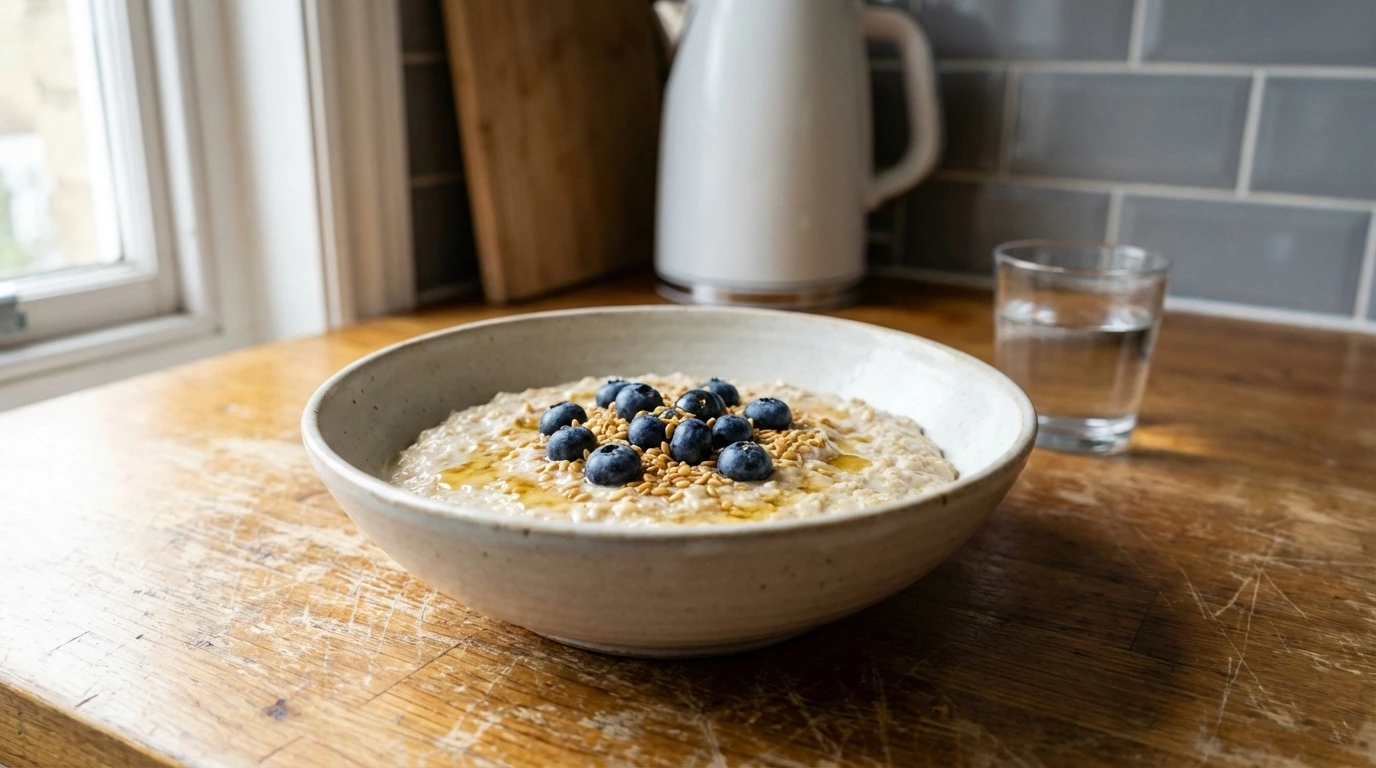
- Oats — around 4g of beta-glucan per 80g serving of porridge
- Lentils and chickpeas — a 400g tin of lentils provides roughly 8g of fibre, much of it soluble; costs pennies and works in virtually any soup or curry
- Apples and pears — the pectin in their flesh is a key soluble fibre
- Linseeds (flaxseeds) — a tablespoon adds 3–4g; largely tasteless and easy to stir into porridge, yoghurt, or a smoothie
- Psyllium husk — the most concentrated soluble fibre source available; one tablespoon delivers around 5g
- Root vegetables — sweet potato, carrots, parsnips all contribute
The approach I tend to give patients isn’t a dietary overhaul — it’s a two-step nudge. First, identify one fruit or vegetable you already enjoy and eat it more often through the week. When you’re in the supermarket picking it up, look around and find one other produce item to pair with it. That’s it. Two items. The point is to make it feel manageable rather than prescriptive.
Go slowly. Moving from 18g to 30g in a single week will make your gut uncomfortable and vocal. Your gut bacteria need time to adapt to the extra fermentable fibre. Spread any increase over two to four weeks, and drink enough water — the gel-forming mechanism only functions well with adequate fluid.
One note for anyone with IBS or other gut conditions: some soluble fibres are high-FODMAP and can trigger symptoms. This is worth a conversation with a dietitian before dramatically increasing fermentable fibre sources.
The Bigger Picture
The evidence on dietary fibre and long-term health is, by nutrition research standards, unusually consistent. Multiple large meta-analyses of prospective cohort studies all point in the same direction: more fibre, less cardiovascular mortality, less cancer mortality, longer life (Mirrafiei et al., Food & Function, 2023; Yao et al., Frontiers in Nutrition, 2023; Ramezani et al., Clinical Nutrition, 2024). NICE’s cardiovascular disease prevention guideline (PH25) identifies poor diet as a primary modifiable risk factor, and dietary fibre sits at the centre of that evidence base.
There’s something quietly frustrating about the fact that fibre — specifically soluble fibre — gets almost no airtime relative to the noise around supplements, superfoods, and expensive dietary protocols. It doesn’t have a brand. It’s not going to sell anyone a product. A bowl of porridge and a tin of chickpeas are not aspirational content. But the evidence for them is, genuinely, more robust than most things being marketed as transformative for your health.
A tin of lentils in a soup. An extra apple. A tablespoon of linseeds on your breakfast. It sounds underwhelming. The data suggests otherwise.