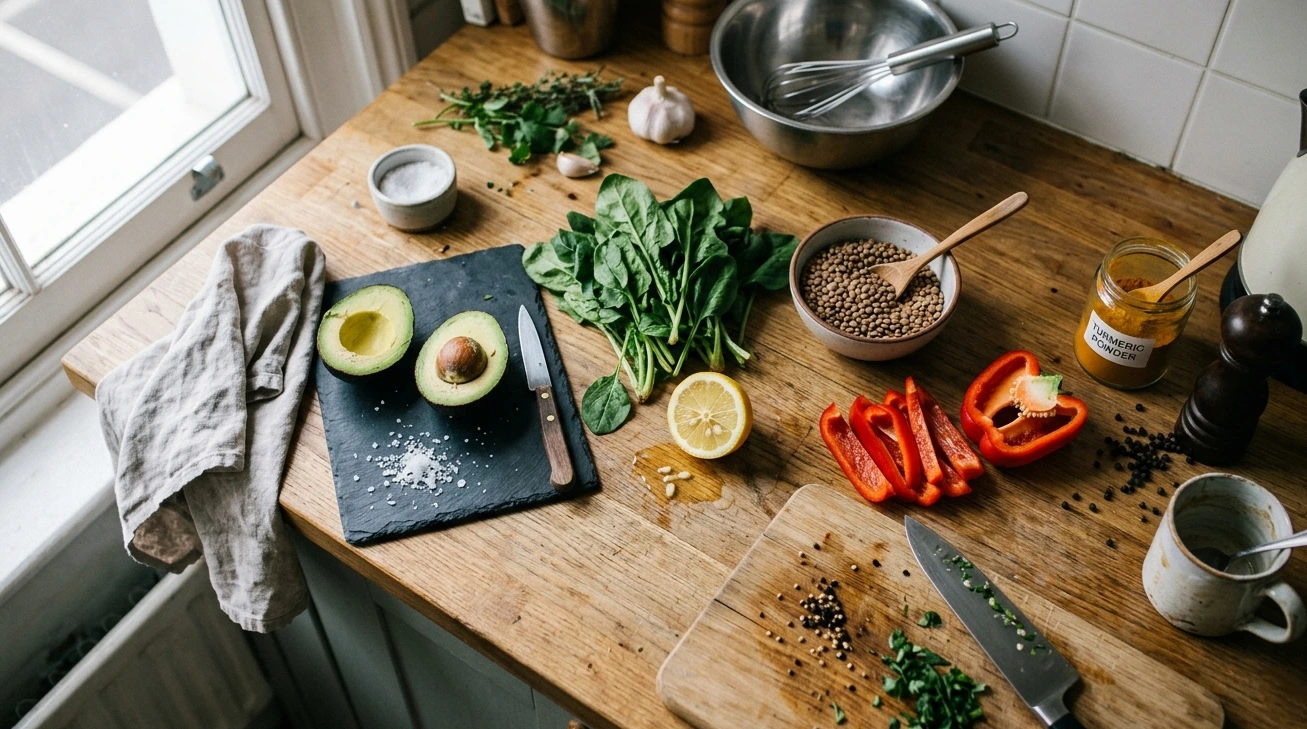
Patients sometimes come to me worried they’re not absorbing enough from their food. They’re eating spinach, taking their iron tablets, drinking their turmeric latte – and still getting told their levels are low. And there’s often a simple reason: what you eat matters, but so does what you eat it with.
The phrase “you are what you eat” is a bit of an oversimplification. You are what you absorb. Your gut isn’t a passive sponge – it’s selective, and the chemistry of your meal affects how much of any given nutrient actually makes it into your bloodstream.
The good news: you don’t need a biochemistry degree to get this right. A few small, practical tweaks can meaningfully improve things. The even better news: if you already eat a reasonably varied diet, most of this is background knowledge rather than urgent action.
Food Combinations That Boost Absorption
Some nutrients are best absorbed alongside a companion that improves their bioavailability – the proportion that actually gets into circulation. Here are the pairings with solid evidence behind them, and the ones I find myself explaining most often in clinic.
Plant-Based Iron + Vitamin C
Iron from red meat (haem iron) absorbs relatively easily. Iron from plant sources – spinach, lentils, fortified cereals – is non-haem iron, and it’s a different story. Phytates, polyphenols and calcium in those same foods can all bind to non-haem iron in the gut, blocking uptake before it gets anywhere near your bloodstream.
The patients I see this conversation coming up with most often are menstruating young women with low ferritin. Many are already eating reasonably well – the gap is usually knowing how to get more from what they’re already eating, rather than needing a dramatic dietary overhaul.
Vitamin C changes the picture. It converts non-haem iron into a form the gut can absorb far more readily. So if you’re vegetarian, vegan, or managing iron-deficiency anaemia, this pairing isn’t just a nice idea – it’s genuinely useful. Practical options: a squeeze of lemon over a lentil dahl, sliced peppers in a spinach salad, or a small glass of orange juice alongside your iron-rich breakfast. Nothing exotic required.
Turmeric + Black Pepper
Curcumin – the active compound in turmeric – has attracted a lot of attention for its potential anti-inflammatory properties. The catch is that the body struggles to absorb it. Most of what you consume in a curry or a golden latte passes through without doing much at all.
Black pepper contains piperine, which appears to significantly enhance curcumin absorption. A 2017 study found the increase could be as high as 2,000%. That’s a headline-grabbing figure. How much it translates into meaningful day-to-day improvements in inflammatory markers – let alone noticeable changes in how you feel – is a lot more variable. Your mileage may genuinely vary on this one. That said, it costs nothing to add a twist of black pepper when you’re cooking with turmeric, and the mechanism is plausible enough to be worth doing.
Fat-Soluble Vitamins + Healthy Fats
Vitamins A, D, E and K are fat-soluble, which means they need dietary fat to be absorbed properly. Eat them without fat and a significant proportion simply isn’t taken up. This is relevant not just for food, but for supplements – there’s little point taking a vitamin D capsule on an empty stomach first thing in the morning.
Practically, this isn’t hard to manage. Drizzle olive oil over roasted carrots (beta-carotene, which converts to vitamin A). Add half an avocado to a kale salad (vitamin K). Take your multivitamin with a meal rather than separately. None of this requires a dramatic overhaul of how you eat.
Food Combinations That Block Absorption
A balanced, varied diet generally compensates for most of these effects without you needing to do anything about them. But if you have a known deficiency or you’re monitoring a specific nutrient, it’s useful to know where the interference is coming from.
Tea or Coffee + Iron
Tannins and polyphenols – the compounds that make tea and coffee what they are – are excellent antioxidants. They’re also efficient at binding to non-haem iron in the gut, forming complexes that are too large to be absorbed. Your cup of tea isn’t ruining your diet. But if you’re already low in iron, the timing matters.
The evidence suggests that having tea or coffee an hour before or after a meal has negligible effect on iron absorption. Having it with the meal is where the interference happens. So if you’re eating an iron-fortified breakfast cereal and washing it down with a strong brew, you’re reducing the benefit. Leave an hour’s gap and the problem largely disappears.
This is particularly relevant for vegetarians and vegans, who are relying on non-haem iron sources. Worth knowing – though I’d add that iron deficiency usually has multiple causes, and timing your tea is rarely the whole answer.
High-Oxalate Greens + Calcium
Spinach, beet greens and Swiss chard contain oxalates – naturally occurring compounds that bind readily to calcium to form calcium oxalate. Once that happens, the calcium is effectively unavailable to the body. The oxalate itself, if unbound, can travel to the kidneys and contribute to stone formation in people already prone to them.
Honestly, I’ve never had a patient come to me specifically worried about spinach causing kidney stones – it’s more of an academically interesting interaction than a common clinical concern. But it’s worth knowing, particularly if you have a history of calcium oxalate stones. What you do about it depends on what you’re trying to achieve:
- If you want to improve calcium absorption: steaming your greens reduces oxalate content significantly. Adding a vitamin C source – broccoli, peppers, citrus – helps further.
- If you’re prone to kidney stones: pair your high-oxalate greens with a calcium source, such as cheese or a yoghurt-based dressing. The calcium binds the oxalate in the gut rather than letting it reach the kidneys.
- If you have any concerns about kidney stones: this is worth a specific conversation with your GP, because the advice varies depending on what type of stones you’ve had and your overall diet.
Phytates (Grains and Legumes) + Zinc and Iron
Phytic acid is a natural compound found in the outer hulls of grains, nuts, seeds and legumes. It’s sometimes labelled an “anti-nutrient” because it can bind to zinc, magnesium and iron in the gut, reducing how much you absorb. For people eating a largely plant-based diet, this is more relevant than it is for omnivores – beans and lentils are doing a lot of nutritional heavy lifting.
The practical fix is reassuringly low-tech. Soaking beans and lentils before cooking degrades phytic acid substantially. Sprouting grains does the same. And fermentation – as in sourdough bread – reduces phytate levels compared to standard yeasted bread. These are processing methods people have used for centuries, without knowing the mechanism. Turns out they were onto something.
Alcohol + B Vitamins
Alcohol interferes with the absorption of several B vitamins – particularly thiamine (B1), B12 and folate. It does this by damaging the gut lining cells responsible for their uptake, and by affecting how the liver processes them.
Two groups in particular are worth flagging this to. The first is anyone drinking regularly above the recommended guidelines – I’d actively suggest supplementing B vitamins in that situation. The second is vegan and vegetarian patients, where the diet already limits B12 intake significantly; add regular alcohol into the mix and the deficit compounds quickly. If you’re pregnant and taking folic acid, a regular glass with dinner isn’t as neutral a habit as it might seem.
A Few Practical Points
Don’t Let This Become Another Thing to Worry About
A varied diet covers most of these bases automatically. The interactions above matter most if you have a diagnosed deficiency, are eating a very restricted diet, or are managing a condition where specific nutrients are critical. If none of that applies to you, this is useful context rather than a checklist you need to work through before every meal.
Supplement Timing Is Worth Getting Right
Most multivitamins contain fat-soluble vitamins – A, D, E and K. Taking them with a meal that includes some fat is going to be considerably more effective than taking them on an empty stomach. If you’re on multiple supplements, it’s worth checking for interactions – calcium and iron compete for absorption, for instance, so spacing them out makes sense. And if you’re unsure, the packet instructions are there for a reason.
Raw and Cooked Both Have Their Place
Cooking isn’t straightforwardly good or bad for nutrients. Heat increases the bioavailability of lycopene in tomatoes – which is why tinned tomatoes are nutritionally solid. But it destroys some vitamin C, which is why overboiled veg loses much of its value. The simplest approach: eat a mix of raw and cooked vegetables across the week, rather than obsessing over individual meals. That variation takes care of most of it.