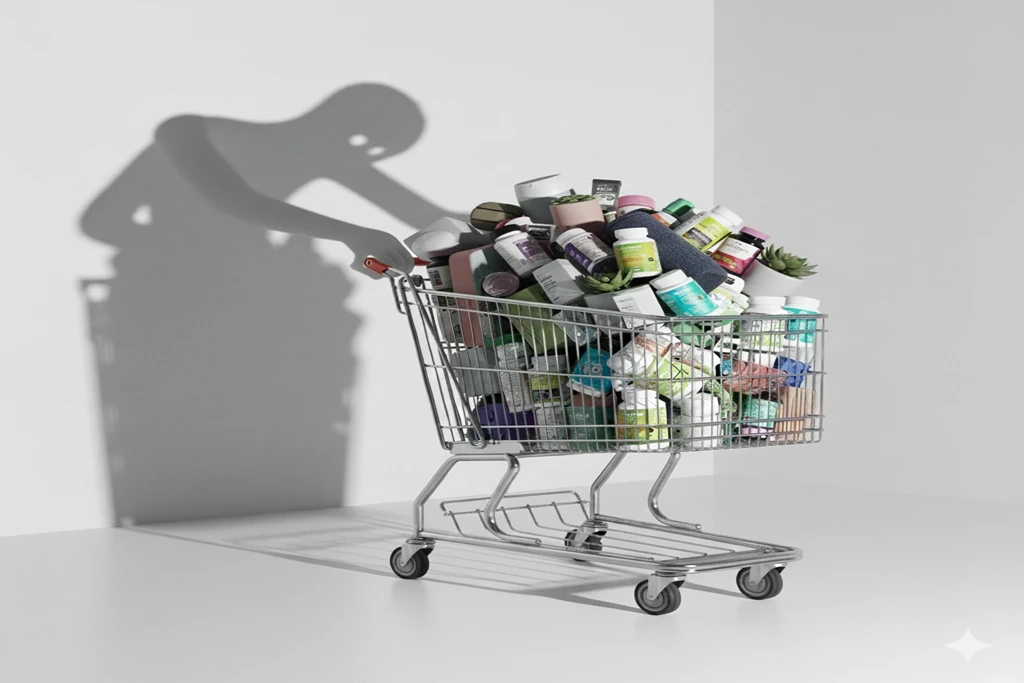
I see it in clinic, though not always in the way you might expect. It’s rarely someone who walks in and says “I’m exhausted by wellness.” What I notice more often is a kind of background hum of anxiety – a sense, in certain patients, that they could be optimising more and that somehow they’re falling short. Someone comes in tired, vaguely restless, not sleeping well – and when you ask what they’re already doing about it, the list is exhausting just to hear. Sleep tracking. Morning meditation. Protein targets. Supplement stack. Gym five days a week. A breathwork app at lunch. By the time they finish, I’m half worn out on their behalf.
This is what some researchers are calling “wellness fatigue” – not burnout from overwork, but burnout from the relentless pursuit of being well. And it turns out it’s remarkably common.
The global wellness industry reached $6.8 trillion in 2024, more than double its size since 2013. That same year, 91% of UK adults reported high or extreme stress. We’re spending more on wellness than ever before. Yet we’ve never been more stressed. Something doesn’t add up.
What Exactly Is Wellness Fatigue?
It’s worth separating this from ordinary burnout. Standard burnout comes from chronic overwork – impossible demands, too many hours, not enough recovery. Wellness fatigue flips that. It comes from too much self-care, too many optimisation strategies, too much pressure to be perfectly well. Two different problems. Easily confused.
Think about what that looks like in practice. There are 227,500 health apps available in the UK. Your yoga practice has stopped feeling restorative and started feeling obligatory. You’re tracking sleep, steps, calories, macros, meditation minutes, and mood – and feeling guilty when any number comes up short. That mental overhead is genuinely depleting.
A Mental Health UK survey found 45% of people experience “wellbeing burnout” – feeling powerless to improve their wellbeing while simultaneously feeling pressured to be, and appear, well. Among Gen Z that figure rises to 73%. Women bear a disproportionate share of it: 69% report burnout compared to 56% of men.
The signs are pretty recognisable. Your supplement cabinet fills you with dread rather than hope. Scrolling wellness content leaves you feeling worse about yourself. You’d rather abandon your evening routine entirely than face one more self-care decision. That’s not a character flaw. That’s your nervous system telling you something.
The Perfect Storm: Why Wellness Exhausts Us
How did we arrive here? Several forces converged at once, each reinforcing the others, turning wellness from something you do into something you perform and fail at.
Social Media’s Comparison Olympics
Search #wellness on TikTok and you’ll find 16 billion views. Instagram’s #fitspiration sits at 66.1 million posts. Flooding through every feed, daily: perfectly curated morning routines, immaculate meal prep, and impossibly toned bodies – all suggesting that this is what a healthy person looks like and this is what a healthy person does.
The problem isn’t just the volume. Analysis of top trending mental health advice videos on TikTok found around half contained misinformation. Separate research found time spent on Instagram predicts body surveillance and appearance comparisons. Following strangers on Instagram correlates with increased negative social comparisons and depressive symptoms. What started as inspiration has quietly become a 24-hour comparison loop. Nobody’s winning it.
Capitalism Learned to Monetise Your Anxiety
The wellness industry grew from $3.4 trillion in 2013 to $6.8 trillion in 2024 and is projected to hit $9.8 trillion by 2029. That’s 7.6% annual growth – well above the 4.5% projected for global GDP. This isn’t a health revolution. It’s a market.
Barbara Ehrenreich, a cellular biologist turned social critic, spent years picking apart wellness culture. Her assessment was blunt: the industry offers an “illusion of control” – the suggestion that we can perfect our health through the right products. That framing, she argued, amplifies anxiety rather than relieving it.
The mechanism is fairly straightforward. Economic pressure and overwork create stress. The industry then sells you the cure: meditation apps, supplements, boutique fitness, wellness retreats. None of this addresses what’s actually causing the stress. It just creates more things to buy, more routines to maintain, more ways to feel like you’re falling short when you can’t afford or sustain them.
What used to be free – a walk outside, a simple meal, going to bed when you’re tired – now comes packaged with a price tag and a marketing campaign. We’ve had our own self-soothing sold back to us.
My own position, for what it’s worth: I’m a proponent of lifestyle medicine – the kind of healthy practices that have real evidence behind them and that promote long-term health and wellbeing. What I’m less keen on are the fads. They come and go, and in my experience they distract people from what the hard evidence actually supports. When a patient asks me whether they should try the latest supplement or protocol, the honest answer is usually: probably not. Do the boring things well instead.
The Productivity Paradox of Self-Care
Working more than 50 hours a week reliably produces declining output – more input, worse results, eventual breakdown. The same pattern plays out with wellness. But rather than recognising that, we’ve turned self-care into another optimisation project.
There’s a concept called “cruel optimism” – the idea that the promise of wellness stays permanently just out of reach, always one more product or habit away. You’re never quite rested enough, fit enough, mindful enough. You’re in permanent pursuit of wellbeing rather than actually experiencing any of it.
When was the last time you rested without framing it as an investment in your future productivity? We sleep to perform better. Meditate to focus more. Exercise to have more energy for work. Rest has become a tool, not a need.
The evidence points in an uncomfortable direction: pressure not to experience negative emotions is itself a predictor of depressive symptoms. The harder we chase wellness, the further it recedes.
Drowning in Information
Is coffee good for you? Depends which study you read this week.
Of the 227,500 health apps in the UK, 85% have fewer than 5,000 downloads. We’re paralysed by choice, not helped by it. One researcher studying health misinformation put it starkly: “nothing comes even close to [health and wellness’s] ability to attract people’s attention and convince them to let their guard down.”
Keto? Paleo? Vegan? Intuitive eating? And that’s just what you might have for dinner. Every choice depletes something. By the time you get home from a full day, ordering a takeaway isn’t a failure of discipline – it’s a rational response to having made too many decisions already.
For practical approaches to managing overwhelming stress, see our guide on stress management strategies that actually work
When Wellness Becomes Moral Obligation
Perhaps the most insidious shift is this: wellness stopped being a personal choice and became a moral category. You’re not just eating – you’re either “clean eating” or indulging in “dirty” food. You’re not resting – you’re being lazy. You’re not making different priorities – you’re failing at self-care. That language does real damage.
Around 30% of workers cite financial pressure as their main stress source. Many continue spending on wellness despite that – because it’s become tied to being a good, responsible person. Opting out feels like admitting defeat.
When rest feels like failure, self-care has stopped being care at all.
Who Bears the Burden?
Wellness fatigue doesn’t distribute evenly. It maps almost exactly onto existing inequalities.
Women bear a disproportionate load. 69% report burnout versus 56% of men. They score higher across negative affect measures, report more bad mental health days, more disrupted sleep, lower life satisfaction. The gap is consistent and significant.
Wellness culture compounds this. Analysis of Instagram wellness content found it predominantly depicts thin or athletic bodies, reinforcing narrow ideals. The commercialisation of self-care targets women specifically – capitalising on gendered insecurity while framing wellness as both empowerment and obligation simultaneously. Both, at once. It’s a clever trap.
Class matters too, and it’s rarely discussed honestly. Boutique fitness, organic food, dedicated leisure time, access to safe outdoor spaces – these are not evenly distributed. The person squeezing in Pilates before work and finishing a protein smoothie by 8am is describing a very particular kind of life. Most people’s mornings don’t look like that, and they’re not supposed to feel guilty about it.
Available data suggests around half of consumers use supplements and roughly a quarter maintain gym memberships – this while 30% cite financial pressure as their main stressor. Wellness culture effectively frames health as a consumer choice, available to those who can afford it, while structurally excluding those who cannot.
Gen Z carries this heaviest. 73% burnout rate – the highest of any generation. Among 18-24 year-olds, 35% reported needing time off work for mental health. They’re the first generation to have grown up with wellness culture and social media comparison as a constant backdrop to daily life. And nearly nine in ten people cite loneliness as a stressor. More connected than ever. More isolated too.
The Evidence Mounts
The numbers are hard to ignore. The Global Wellness Institute reports the wellness economy grew 7.9% between 2023 and 2024, reaching $6.8 trillion. The mental wellness segment alone is growing at 12.4% annually. The industry is now larger than pharmaceuticals and sport combined.
Mental Health UK found 91% of UK adults experienced high or extreme stress in 2024 – up from previous years. 45% reported “wellbeing burnout.” And critically, 89% reported having been actively pursuing wellness for more than a year. Stress levels rose anyway.
Nearly nine in ten people doing the right things for over a year. Getting worse, not better.
One industry analyst put it plainly: “The data presents a fascinating paradox: while young consumers are investing more heavily in wellness than any previous generation, they’re simultaneously reporting worse mental health outcomes.”
Is the wellness industry solving the problem, or profiting from it? That’s not a rhetorical question. It deserves a serious answer.
The psychotherapist John Welwood coined the term “spiritual bypassing” in 1984 – using spiritual practices to sidestep unresolved emotional issues rather than work through them. Over forty years later, we’re living in an era of wellness bypassing. Quick fixes with dubious scientific backing, dressed up in the language of health. What’s being sold isn’t health – it’s the fantasy that the uncontrollable can be controlled. Bodies age. Mental health fluctuates. Life is unpredictable. No supplement stack changes any of that.
Breaking Free: Paths Forward
If the mainstream model isn’t working, what does? The approaches that tend to help people aren’t about more consumption, more tracking, or more effortful optimisation. They’re mostly about doing less, but doing it sustainably.
Simplify Radically
The minimalist case for wellness: maximum results, minimal effort. Not because you’re lazy – because sustainability matters more than perfection. A habit you can keep beats an optimal routine you can’t.
A 2021 review of minimalism and wellbeing found more than 80% of participants attributed improved wellbeing to prioritising values over possessions. Decluttering physical space tends to declutter mental space too.
For me, it comes down to three things: diet, physical activity, and sleep. All three have a direct effect on mental wellbeing – not just physical health. I have a minimum amount of movement I need to do to keep myself on an even keel. Diet matters because we eat several times a day, and I want to feel genuinely good about what I’m eating on average – not perfectionistic about every meal. And sleep. That’s the one I have to work hardest at. When I sleep well, the whole world looks different. It doesn’t need to be more complicated than that for most people.
Unfollow the accounts that leave you feeling worse. Delete the apps you don’t use. Stop tracking metrics that don’t meaningfully change what you do. The target isn’t a perfect routine. It’s a sustainable one.
Listen to Your Body, Not the Scale
The Health at Every Size (HAES) approach moves the focus from weight management to health promotion more broadly. Randomised controlled trials suggest HAES improves blood pressure, blood lipids, eating behaviour, self-esteem, and body image – in some studies more effectively than weight loss treatment alone.
One intervention found participants maintained improvements at one-year follow-up. Diet groups lost weight initially but didn’t hold it. The authors concluded HAES enabled longer-term behaviour change where dieting had not.
The broader picture on dieting is bleak. The evidence suggests up to 95% of diets fail over the longer term, and more than two-thirds of dieters end up heavier than when they started. We’ve been repeating the same cycle for decades, blaming ourselves for the failure rather than questioning whether the approach is sound.
It’s worth being clear about what HAES actually claims, because it’s often misread. It doesn’t say that everyone is healthy at any size, and it doesn’t discourage health improvement. What it does is decouple health behaviours from weight as the primary outcome measure. That’s a meaningful distinction – and one that doesn’t always land on first hearing.
Intuitive eating – making food choices from a place of curiosity rather than shame – shows improvements in blood pressure, cholesterol, mood, and overall wellbeing in the available evidence. What would it look like to approach health as listening rather than optimising?
Set Boundaries Like Your Life Depends On It
When the culture frames optimisation as obligation, rest becomes a radical act. The available evidence suggests clear personal boundaries are associated with reduced stress responses, greater resilience to exhaustion, and healthier relationships – though I’d also just point out that most people already know this, and the real barrier is permission to act on it.
- Digital boundaries: Turn off wellness app notifications (Learn more about creating digital boundaries for better sleep and wellbeing)
- Social boundaries: Decline wellness-related pressure. “No, I’m not doing Whole30.” Full sentence. No justification required.
- Temporal boundaries: Protect non-wellness time. Rest without tracking it. Eat without logging it.
- Financial boundaries: Set wellness spending limits.
- Emotional boundaries: Give yourself permission to feel the full range of emotions.
Sometimes the most useful thing you can do is acknowledge you’re not okay. And then rest – without trying to optimise the rest.
Reject Toxic Positivity
Toxic positivity – the insistence on cheerful conformity regardless of circumstances – invalidates genuine emotion. The evidence points to social pressure not to experience negative emotions as a predictor of depressive symptoms. Forcing positivity makes things worse, not better.
Sadness carries information about loss. Anger signals a boundary being crossed. Anxiety is alerting you to something. These aren’t malfunctions to be corrected – they’re signals worth paying attention to. Real therapeutic change doesn’t happen through an Instagram moment. It happens through what one therapist described as “long, repetitive hours” of working things through.
You don’t have to turn every difficult period into a growth narrative. Sometimes you get through something, feel it fully, and move on. That’s enough.
Think Collectively, Not Just Individually
Genuine wellbeing isn’t something you purchase or achieve in isolation. The evidence on sustainable health consistently points toward social connection, community belonging, and shared responsibility – not individual optimisation.
Loneliness carries a health risk comparable to smoking. Yet the prevailing response is more individual wellness practices, more apps, more self-improvement. It doesn’t address the actual problem. We need each other – friends who listen without immediately trying to fix things, community spaces, mutual support networks.
The structural determinants of health – fair pay, decent housing, accessible healthcare, safe environments – matter far more than any individual wellness habit. By framing health as personal responsibility, the wellness industry deflects attention from those structural realities. That’s worth noticing.
When you encounter wellness marketing, it’s worth asking: who profits from this message? What are they actually selling? As one researcher put it, “We want that elixir that can fix this emotional issue” – but chasing that elixir through consumption tends to intensify the very problems it claims to solve.
The Path Forward
A $6.8 trillion industry and 91% of UK adults under high or extreme stress. That’s not a coincidence. It’s a symptom of something the industry has little interest in naming: consumption is part of the problem, not the solution.
If you’re experiencing wellness fatigue, you’re not failing at self-care. You’re responding sensibly to a system that’s designed to keep you dissatisfied. The exhaustion serves a purpose – it keeps you searching for the next fix, the next purchase, the next upgrade.
Getting out of that loop isn’t about trying harder. It’s about choosing differently – and demanding better from the systems around you. That means personal boundaries and genuine simplicity. It also means asking who profits from the current setup and whether we could be advocating for structural changes instead.
There’s no tidy resolution here. Naming the problem doesn’t make it go away. But it does change your relationship to it. When you can see the forces driving the exhaustion, you’re better placed to stop internalising it as personal failure.
Real wellness is inconsistent and unglamorous. It’s rest without tracking it, food without logging it, feelings without reframing them. It’s knowing you’re enough without any further optimisation required. Maybe that’s the most subversive thing you can do right now.